
Hill Times: Canada’s electricity buildout needs Indigenous leadership
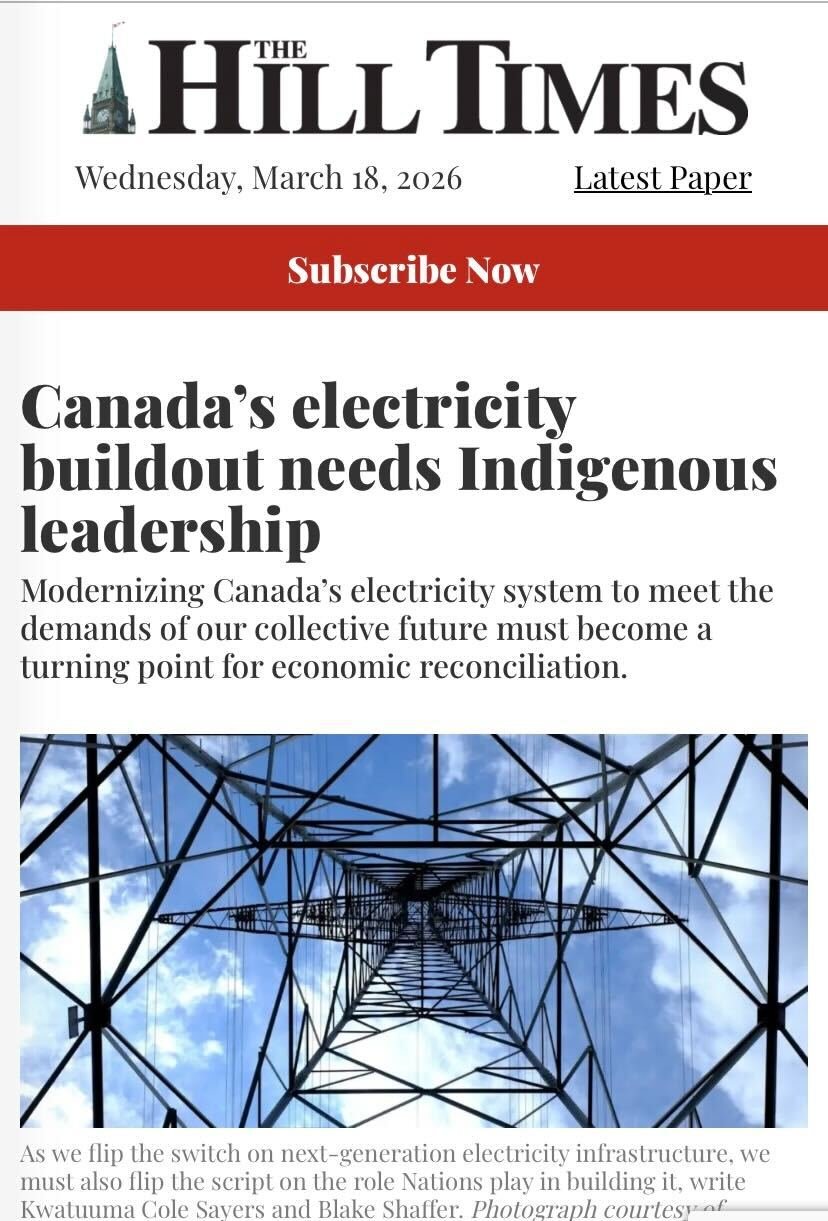
Modernizing Canada’s electricity system to meet the demands of our collective future must become a turning point for economic reconciliation.
As published in the Hill Times
By Kwatuuma Cole Sayers and Blake Shaffer
Canada is talking about doubling its electricity system. But what’s often lost in that conversation is the sheer physical scale of what that means. “Doubling the grid” may sound abstract, but in reality, it means multiple, massive, decades-long construction projects spanning some 160,000 kilometres of forest, river, and mountain. These projects will not be built in nameless places. They will be built across Indigenous homelands. Every new transmission line in Canada will cross Indigenous territories.
What does this necessary nation-building enterprise mean for Nations? It should mark a turning point in how Indigenous leadership shapes Canada’s electricity future. As we flip the switch on next-generation electricity infrastructure, we must also flip the script on the role Nations play in building it—from consulted communities and Rightsholders to project proponents and leaders.
Too often, the process follows a familiar pattern. A commercial proponent identifies a major development opportunity and then determines which Indigenous Nations may be impacted. Sometimes it is five, ten, or twenty-five Nations. Consultation begins, often Nation by Nation, but many key decisions have already been made: the route, the timeline, and the benefits on offer. Nations are then placed in the position of responding, negotiating, and seeking to influence projects largely designed by others. Sometimes Nations are viewed as obstacles to overcome, sometimes as collaborators and equity partners.
Ownership stakes generate long-term, predictable revenue, create jobs, build capacity, and reflect recognition of Nations’ rights and title. But Nations holding passive equity in projects conceived, structured, and largely governed by others is not an endpoint. It is a transition point.
To achieve true economic reconciliation, Nations must be behind the wheel of projects from inception. That means defining the project vision, selecting partners, shaping governance, negotiating with regulators, and deciding how risk and return are shared. Capital is mobilized in service of Nations’ priorities, not the other way around.
Interprovincial transmission infrastructure, in particular, requires this shift for three key reasons. First, the implementation of free, prior, and informed consent as required by Canadian law. Second, the need to address inadequate grid infrastructure that constrains economic development for Indigenous Nations. And third, overcoming the traditional hurdles to interprovincial cooperation around electricity planning.
In 2021, the UN Declaration on the Rights of Indigenous Peoples Act became law in Canada, enshrining the legal imperative for free, prior, and informed consent for infrastructure projects that impact Indigenous territories. Implementation has been uneven, and lack of clarity around what this means in practice has contributed to court battles and project delays.
Given the scale of interprovincial transmission projects, construction of a single line could impact and require the consent of dozens of Nations. Indigenous project leadership does not guarantee unanimous agreement among all involved. However, it centers the conversation between Nations and focuses it on self-determination. This creates a stronger foundation for building authentic consent and shared decision-making, and it ultimately makes projects more likely to get built.
Grounding transmission conversations in community priorities is also critical because many Indigenous Nations still face unreliable, outdated, or non-existent grid infrastructure. This restricts Nations’ ability to develop economic opportunities in their territories, adopt new technologies, or participate in larger-scale renewable generation.
Finally, Indigenous leadership may be key to unlocking stalemates that have long plagued interprovincial transmission. Nations can work across provincial borders in ways provincial governments often struggle to, advancing collaborative electricity planning across regions. With political and geographic relationships that long predate Confederation, Indigenous Nations are well positioned to convene partners, work with regulators and governments, and align behind projects that benefit communities across landscapes for generations.
Modernizing Canada’s electricity system to meet the demands of our collective future must become a turning point for economic reconciliation. These decisions are not only about building infrastructure, but also about how Nations exercise their inherent rights to plan for their homelands and communities. As Canada builds the next generation of electricity infrastructure, Indigenous Nations must be leaders in shaping it. That will define the legacy of this moment in Canada’s evolution.
Kwatuuma Cole Sayers is a member of the Hupačasath Nation, former head of Clean Energy BC, and executive director of the newly launched Indigenous Power Coalition. Blake Shaffer is an Associate Professor at the University of Calgary specializing in electricity markets.
